President Donald Trump said Wednesday that U.S. special envoy Steve Witkoff and his son-in-law Jared Kushner had a “reasonably good meeting” with Russian President Vladimir Putin during high-stakes negotiations in Moscow, adding that U.S. negotiators believed Putin “would like to end the war.”
“I don’t know what the Kremlin is doing. I can tell you they had a reasonably good meeting with President Putin. We’re going to find out. It’s a war that should never have started,” Trump told reporters in the Oval Office.
Trump said he spoke with Witkoff and Kushner on Tuesday night after their meeting at the Kremlin.

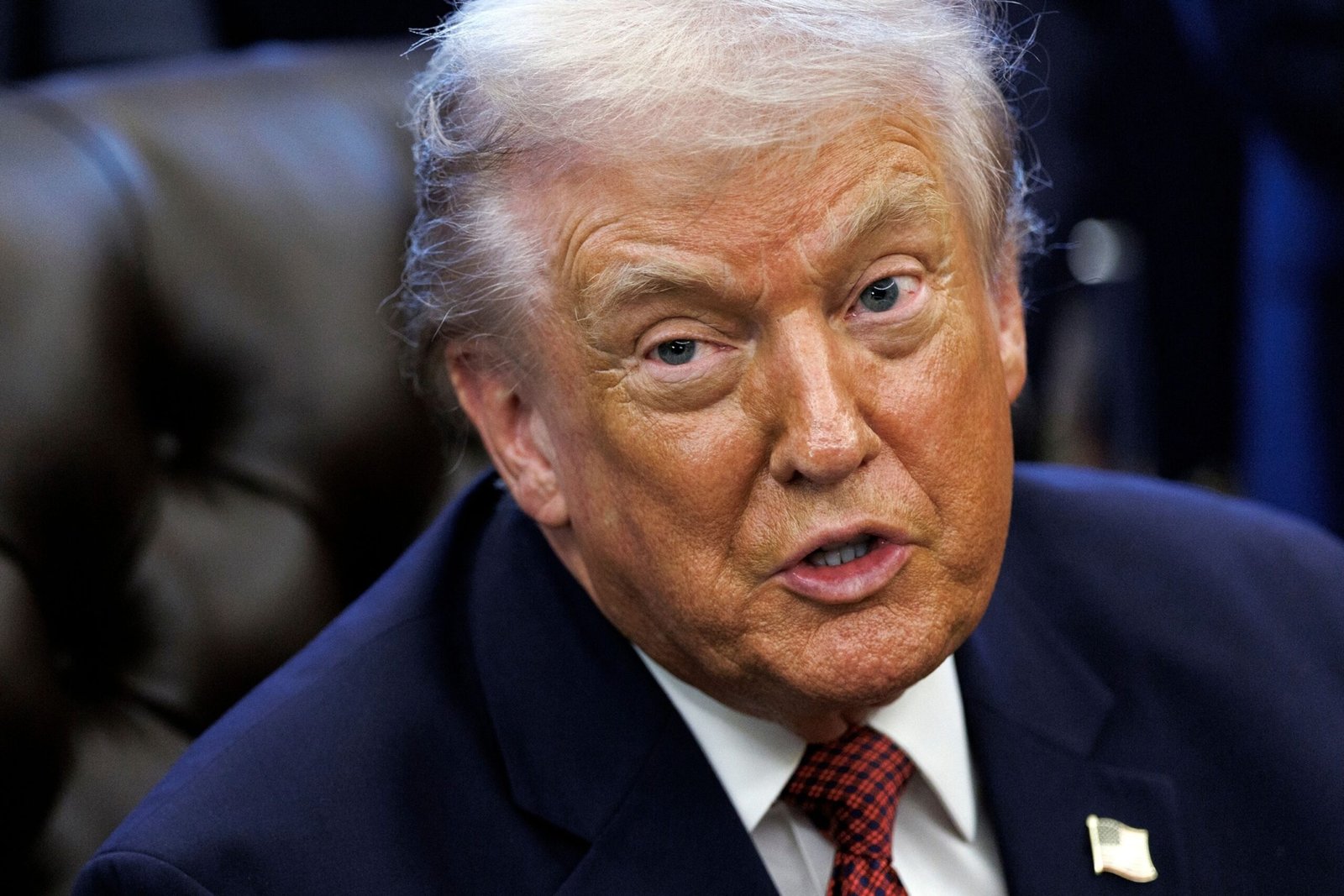
President Donald Trump speaks to the media in the Oval Office of the White House in Washington on December 3, 2025.
Will Oliver/EPA/Shutterstock
“What comes out of that meeting? I can’t tell you, because it takes two to tango,” Trump said.
“He would like to end the war,” Trump said of Putin. “That was his impression. Now, whether or not you know that was his impression, you know that his impression was that they would like to see that he would like the war to end.”

Russian President Vladimir Putin attends a meeting with President Donald Trump’s special envoy Steve Witkoff and his son-in-law Jared Kushner at the Kremlin in Moscow, Russia, December 2, 2025.
Alexander Kazakov/Sputnik via Reuters
“I think he would like to go back to living a more normal life. I think he would like to trade with the United States of America, frankly, instead of losing thousands of soldiers a week. But his impression was very strong that he would like to make a deal,” Trump said of Putin.

Russian President Vladimir Putin, accompanied by Kremlin Economic Envoy Kirill Dmitriev and Kremlin Assistant Yuri Ushakov, meets with Special Envoy Steve Witkoff and Jared Kushner at the Kremlin in Moscow on December 2, 2025.
Alexander Kazakov/POOL/AFP via Getty Images
Witkoff and Kushner invited Ukrainian National Security and Defense Council Secretary Rustem Umerov to Miami on Thursday to continue peace talks, according to a senior US administration official.
Witkoff and Kushner held marathon talks with Putin to bring about an end to Russia’s nearly four-year invasion of Ukraine, but neither side announced immediate progress.
Although both sides in the negotiations – led by Witkoff and Kushner of the US – and Putin, who conducted the negotiations in Moscow, were sworn to secrecy and did not provide full reports of their discussion, it became clear that there was still no peace deal at hand as Trump had long desired.
“No compromise option has been found so far, but some American proposals seem more or less acceptable,” said Putin’s top foreign policy adviser, Yuri Ushakov, who was in the Moscow meeting room and spoke to Russian media afterwards. “The president did not hide our critical or negative opinion on certain proposals.”
“We agreed on some things… while others drew criticism, and the president [Putin] We also do not hide our critical, even negative, attitude towards a series of proposals. But the most important thing is that we had a very useful discussion,” Ushakov said.

President Donald Trump’s special envoy Steve Witkoff and his son-in-law Jared Kushner attend a meeting with Russian President Vladimir Putin at the Kremlin in Moscow, Russia, December 2, 2025.
Alexander Kazakov/Sputnik via Reuters
It is unclear what peace plan was presented to the Russians after details of an initial 28-point plan were presented to Ukraine last month. kyiv and its European allies worked quickly to modify it and reduce it to a 19-point plan.
None of the parties involved in this week’s negotiations have detailed the current version of the proposal.
Following the high-profile meeting between Witkoff, Kushner and Putin, in which the US delegation presented Putin with four documents outlining Washington’s plan, Ukrainian President Volodymyr Zelenskyy said kyiv negotiators would meet European leaders in Brussels on Wednesday to discuss the outcome of the Kremlin meeting.
He added that chief negotiator Umerov and army chief Andrii Hnatov would then prepare for meetings with American envoys.
Geopolitical experts believe that the essence of the entire peace plan between Ukraine and Russia now depends on two main points: territorial concessions and security guarantees.
Major obstacles remain to a peace agreement
U.S. Secretary of State Marco Rubio, who was not part of the U.S. delegation sent to Moscow, said late Tuesday that “some progress” had been made on the truce proposal, but that “we’re not there yet, we’re not close enough yet.”
He stressed that “only Putin can end this war on the Russian side.”

Secretary of State Marco Rubio, left, and Rustem Umerov, Ukraine’s Homeland Security secretary, speak to the media on Sunday, Nov. 30, 2025, in Hallandale Beach, Florida.
Terry Renna/AP
He also highlighted a major sticking point in the peace deal: Moscow’s continued demand that Ukrainian forces withdraw from the entire Donbas region. Ukraine has long refused to cede territory to Russia.
“What they are literally fighting for now is 30 to 50 kilometers of space and 20% of the Donetsk region that is left,” Rubio said on Fox News. “And so what we’ve tried to do – and I think we’ve made some progress – is figure out what Ukrainians could live with that would give them security guarantees for the future that they will never be invaded again.”
Rubio further highlighted that the peace plan should also address Ukraine’s long-term sovereignty and independence “so that they do not become a puppet state” while allowing Ukraine’s economy to recover and prosper.
“That’s what we’re trying to accomplish here,” Rubio said.
John Hardie, deputy director of the Russia program at the Foundation for Defense of Democracies, said that if the Kremlin refuses to come to the negotiating table, a peace deal will remain elusive.
“The Kremlin remains unwilling to make the compromises necessary for a deal that kyiv can live with. Until that changes, President Trump’s diplomatic efforts are unlikely to produce a deal, much less one that protects the interests of the United States and Ukraine,” Hardie told ABC News. “Washington needs to work with its allies and Ukraine to maximize military, economic and diplomatic pressure on Moscow.”
But Rubio emphasized in his television interview that it is up to both Ukraine and Russia to resolve their differences to achieve lasting peace.
“And at the end of the day, it’s not up to us. It’s not our war. We are not fighting against it; There are no American soldiers. It’s on another continent. We are committed because we are the only ones who can,” he said. “The only leader in the world who can talk to both sides and reach an agreement, if possible, is President Trump. And he has been very patient. “He has dedicated a lot of time to it.”
“Ultimately it will be up to them. If they decide they don’t want to end the war, then the war will continue,” he added.
Michael Froman, president of the Council on Foreign Relations, said it was in Putin’s interest to “keep the process going, to have a long process of diplomatic engagement.”
“He wants to have a broader conversation about Russia’s reintegration with the West and relations with the United States, trade deals with the United States, and make it long and drawn out while continuing to bomb Ukraine’s energy infrastructure and making incremental progress on the ground,” Froman said during a televised interview Tuesday.
ABC News’ Hannah Demissie contributed to this report.